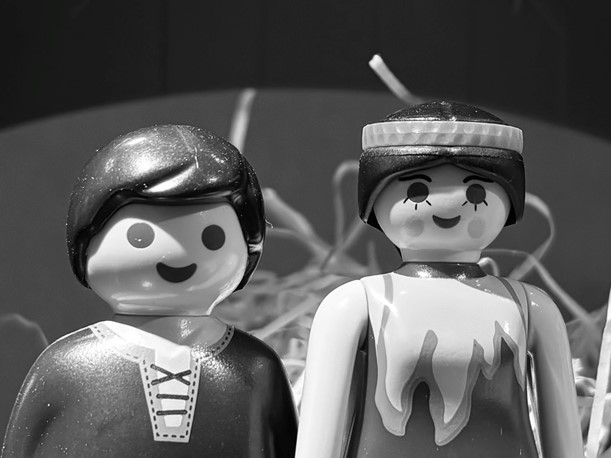
Oh Mary! - the positive impact of good decision making A charming tradition is now developing as my grandchildren visit on Christmas Eve, before heading home to their own beds to await Santa’s arrival. It all began three years ago, when the eldest was gifted a Playmobil nativity set, the contents of which annually appear out of a slightly ageing box.
The set is simple, made up of several brightly coloured plastic figures, several appropriate animals and an obligatory manger, all placed under a shiny red stable awning. This scene is duly positioned on a windowsill at the top of the stairs.
But the suspense begins each year as the box opens and we identify who’s gone missing during its eleven-month storage. Over the years we’ve so far lost a shepherd and a cow and then more critically last year, a wise man. Curiously the man in question was later spotted during the Summer at the bottom of the garden, presumably dropped there, or possibly now following an alternative star.
On reflection, these missing cast members previously caused little concern.
The remaining shepherds filled the space adequately and, as the missing wiseman’s gift of myrrh was never really understood, it was comfortably re-packaged with frankincense, as a joint gift for the baby, from the remaining two.
However, the drama this year was at a much higher level… Mary was missing!
And Christmas Eve is a critically untimely moment for her to be absent. News of the drama spread and whilst my first thought was to quietly put everything back into the box, I was over-ruled and an alternative decision was swiftly shaped by the ‘nativity team’.
It appears that Playmobil also produce a Circus set, which had been traced to the loft and the contents already retrieved, so the nativity could be re-cast.
A turbaned lion-tamer stepped into the role of Shepherd No.2 and, after removing his Top Hat and whip, the Ringmaster proudly became the third wiseman (with myrrh duly returned). Finally, joining Joseph, was his new Mary, fresh from the trapeze and still wearing her purple feather headdress and sash, that everyone voted must not be removed.
It all looked splendid and the enthusiasm for the new fusion of circus and nativity approach continued. When I later returned, lions had joined the sheep and elephants had joined the camels. Finally, a box-office caravan was added outside the stable with an illuminated ‘one-night only’ sign, which on reflection, proved quite fitting.
Good decision-making saved the day - the nativity team stayed focused on the mission to create a wondrous scene, they used the means at their disposal and stayed open to new possibilities and ideas. Interestingly, the ongoing attention and enthusiasm for the display, which usually dwindles moments after completion, continued throughout Christmas, with an insistence that all seasonal callers must step upstairs and view (including a very uneasy Amazon delivery driver).
Maybe it wasn’t the historically traditional Nativity, but in the end, the outcome was hugely positive and sharing the decision making had certainly amplified ownership and commitment.
The answers are in the room - collaborative decision making
At the turn of the century leadership experienced an evolutionary moment. There was a visible shift from command and control to a bolder and more courageous acknowledgement of the need for collaboration. Leaders recognised that they didn’t have all the answers, but saw that with the right team in place, the answers could be developed in the room.
The role of leadership today is not to define all decisions, but to set a clear direction and then jointly identify and align the decisions that need to be made, through balanced team conversations.
This makes sense. The people closest to seeing the challenges and opportunities are usually the ones closest to the ideas for potential solutions. Yet historically they were usually the ones furthest from the resources and decision-making power needed to make things happen.
The skill is getting the right people to the table. Recruiting and positioning those who live the experience to the centre of the decision making isn’t complicated, but it is crucial and requires a shift in mindset and a willingness to share ownership of the outcomes. Direction then becomes a shared system, that unlocks decision making at all levels.
All of this does come with a leadership ‘health warning’. If people join and openly share their insights, but don’t feel their influence in the outcomes, you’re not truly empowering them to take part in the decisions or to have a vested interest in the impact those decisions then have. Consequently, they will simply feel used, and the potential of the table can swiftly dilute.
Once established, any decision-making table needs to feel they have permission to confidently participate, then have visibility and shared accountability for the outcomes. We nearly always make decisions in imperfect conditions so the more informed and relevant those decisions are, the better.
A balanced approach to decision making - a simpler way to make good choices in 2026
How many decisions will you be making in 2026?
There are claims on the internet that the average adult is estimated to make around 35,000 remotely conscious decisions each day, which totals over 12 million decisions per year!
Taking everything we read on the internet with a large pinch of salt, this figure may not be exact, but it’s useful as a narrative that describes us as creatures of many conscious and subconscious choices. If we move aside most of the subconscious decision making and focus on the ‘informed’ choices we make, we are guided to a more manageable estimated figure of over 100 per day… each one being a decision that requires an element of balanced thought.
Navigating the decision-making process is an everyday occurrence for us all, but of critical importance for leaders, whose decision-making capability keeps organisations moving forward (or not!).
We’ve worked with a lot of leaders in the sector, helping them set a compelling direction and identify clear priorities to underpin the decision-making systems in their organisations. If you take a peep at our website, you’ll see the warm comments they’ve made about the experience and how balance was useful to them, which might resonate with what’s happening in your organisation and offer some learnings. Read the case stories on our website for more information
The first thing we do is help you identify and reconnect to who you are, what you do and why you do it. It’s a solid foundation that can guide your choices and will give you real clarity, energy and purpose in your decision-making. We then support you in connecting this to your day-to-day activities, so you can focus on what matters most, have the right conversations at the right time and work together towards the same ends.
This simple balanced approach to decision-making is like finding your centre of gravity. It guides everything you think, feel, say and do. It helps you get clarity on what you’re trying to achieve, be honest about and address the realities you face and make the best choices whilst staying true to what you believe in.
In 2026 we’d like to start a conversation with you and explore together how best to navigate those fast-approaching decisions in the year ahead… or simply help in recasting your nativity!
Make one of your New Years Resolutions to contact us. There’s absolutely no obligation; we simply love the chat and genuinely want to help good people do good things.